St Louis Arch Construction Plan Drawing
We use cookies to ensure we give you the best feel on our website. You tin detect out well-nigh our cookies and how to disable cookies in our Privacy Policy. If you lot go on to apply this website without disabling cookies, we will assume you are happy to receive them. Close.

Gateway Arch
Contents
- ane Introduction
- ii Blueprint
- three Construction
- four Discover out more
- iv.1 Related articles on Designing Buildings Wiki
[edit] Introduction
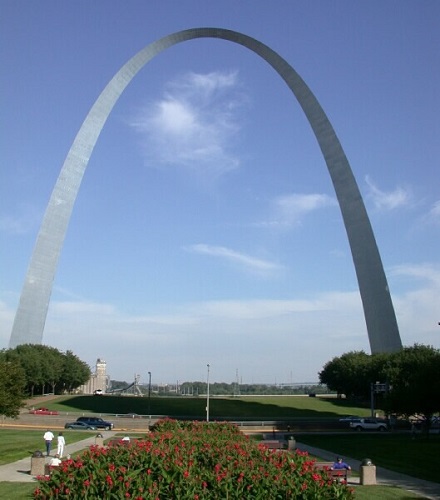
The Gateway Arch is a structural expressionist monument located on the west bank of the Mississippi River in St. Louis, Missouri. It was built as a monument to the westward expansion of the United States. At 192 one thousand (630 ft) in height, information technology is the world's tallest arch, and the tallest man-made monument in the Western Hemisphere.
The idea was conceived every bit function of the Jefferson National Expansion Memorial (JNEM), created in 1935. A nationwide design competition was held in 1947/48 and Ero Saarinen'southward arch was chosen as the winner. Since its completion in 1965, it has get a popular tourist attraction and a defining symbol of the city of St. Louis.
[edit] Design
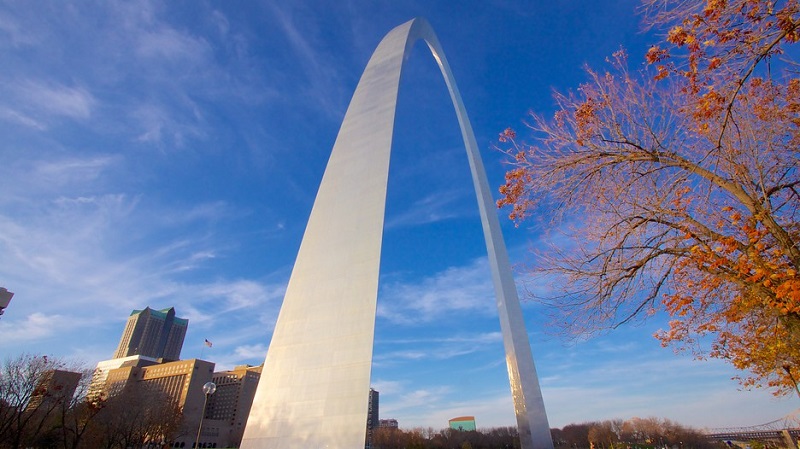
Eero Saarinen conceived of the monument as being clad in stainless steel and congenital in the form of an inverted, weighted catenary arch, a shape such as would exist formed by a heavy chain hanging freely between 2 supports.
The arch spans 192 m (630 ft) between the outer faces of its triangular legs. Each leg is an equilateral triangle, narrowing from 16 yard (54 ft) per side at the bases to five.2 g (17 ft) at the top. Complex mathematical equations were required to ensure the curvation design would work, and the base of each leg at ground level had an engineering tolerance of only 0.4 mm (1/64 inch) to ensure they would see at the tiptop.
Each leg consists of a stainless steel pare covering 2 carbon-steel walls with reinforced concrete sandwiched between them. This continues until 91 g (300 ft), at which signal carbon steel stiffeners are used instead of concrete. These inner and outer stressed-skins join to form a composite structure which carries the self weight and wind loads to the basis.
Each leg is embedded in concrete foundations thirteen m (44 ft) thick and 18 1000 (60 ft) deep. The arch is earthquake-resistant and designed to sway up to 46 cm (18 inches) in either direction, while withstanding winds of upwards to 150 miles per hr.
The curvation is hollow and accommodates a tram arrangement that carries visitors from the lobby to an observation deck at the superlative. Operating at the rate of 340 ft per infinitesimal, the ride takes 10 minutes for the full trip. The ascertainment platform is 65 ten 7 ft, and fitted with plate-glass windows that provide views to the east and west.
[edit] Construction
Construction was postponed during Earth War II, and it wasn't until 1959 that ground was start broken. The foundations were laid in 1961, and the arch construction itself began in 1963 as the starting time steel triangle for the south leg was moved into place.
The steel triangles, narrowing as they spiralled to the peak, were raised into place using a group of cranes and derricks. Once in identify, each section was filled with concrete and prestressed with 252 tension bars. As a means of keeping the partially-completed legs steady, a scissors truss was placed between them at 160 g (530 ft). This was later removed as the derricks were dismantled.
Construction progress was delayed by a combination of funding issues, safety checks and legal disputes. Ceremonious rights activists brought piece of work to a stand-even so as strikes were held in protest against the fact that African-American workers, who were being discriminated confronting, were working on the projection.
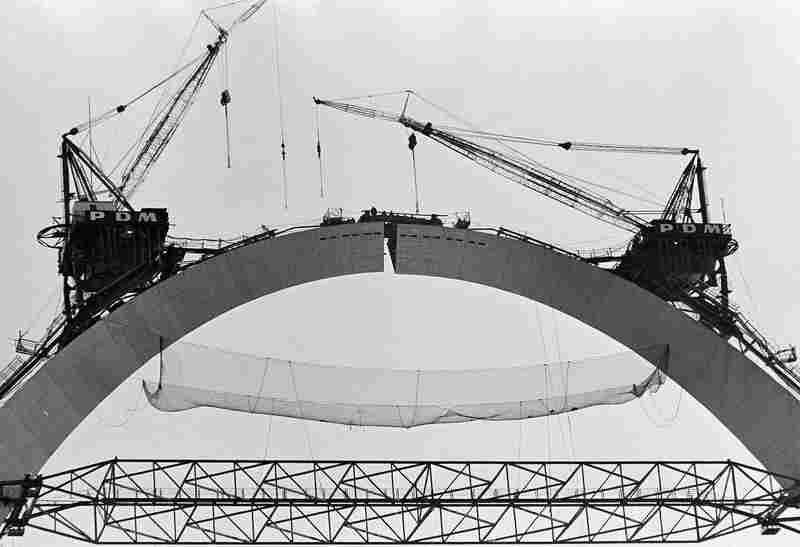
On Oct 28 1965, the curvation was finally topped out. The keystone was a two.4 m (8 ft) long triangular section. To mitigate against thermal expansion, which had constricted the gap at the top past thirteen cm (5 inches), burn down hoses were used to spray water to cool the surface and help it contract. When the keystone was in place, a hydraulic jack was used to pry the legs apart 1.8 m (six ft), with the concluding section being inserted to secure the arch.
Having toll $13 million (equivalent to $190 thousand in 2015), the curvation opened to the public in June 1967.
[edit] Find out more
[edit] Related articles on Designing Buildings Wiki
- 7 Engineering Wonders of the Globe.
- Arches.
- Brandenburg Gate.
- Edifice of the calendar week serial.
- CN Tower.
- Optimal arch bridge.
- Space Needle.
- Stainless steel.
- Structural engineer.
- Wembley Stadium.
bybeeherfulity1941.blogspot.com
Source: https://www.designingbuildings.co.uk/wiki/Gateway_Arch
Belum ada Komentar untuk "St Louis Arch Construction Plan Drawing"
Posting Komentar