Art Instilation Walk as Thought There Are Three Men Behind You
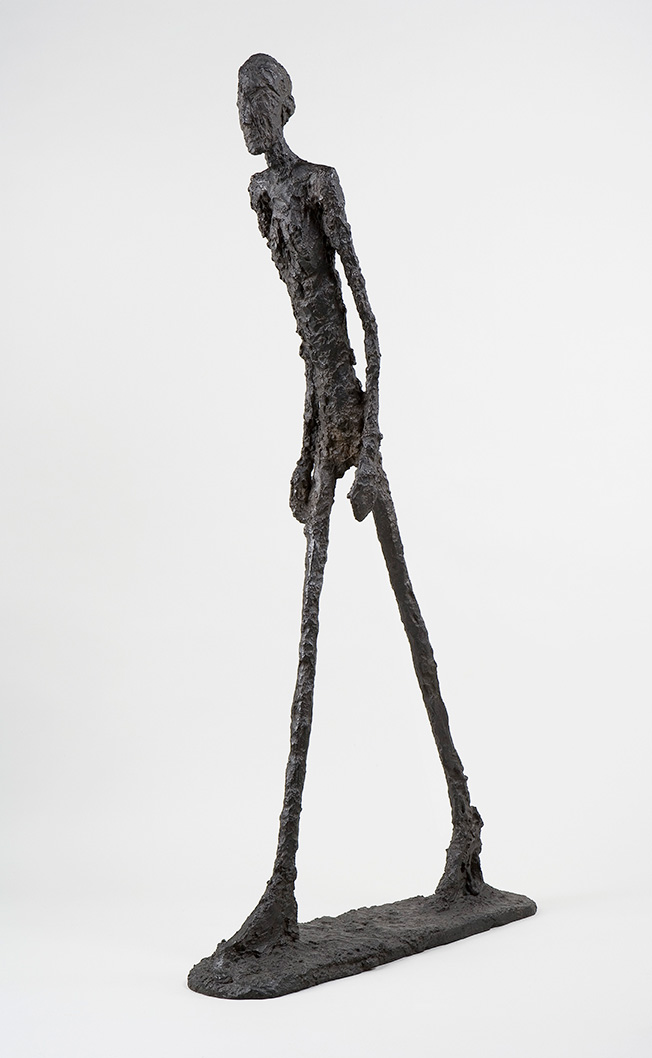
Alberto Giacometti
Walking Man I (Homme qui marche I), 1960
Bronze
180.v 10 27 10 97 cm
Fondation Giacometti, Paris
© Alberto Giacometti Estate / VEGAP, Bilbao, 2018
Introduction
"As if the fabric itself had become an illusion. You have a sure amount of clay, and at first you feel that you've given information technology more or less the correct volume. And so, to make it more real, y'all take abroad. Yous don't practice annihilation just take abroad. It becomes fatter and fatter. But and so, information technology's similar the material itself, you could stretch it to infinity. If you work a little dodder of clay, it seems to get bigger. The more you work it, the bigger it gets." [1]
Throughout his career, Alberto Giacometti (1901–1966) took part in diverse 20th century avant-garde movements. From the 1950s, he felt drawn past existentialism, whose influence is visible in works similar this one, entitled Walking Man I.
Walking Human I is a sculpture from his flow of maturity, the culminating point of his creative career, when Giacometti explored the human figure from unlike angles. The precariousness of the figure relates to the limits within which every man beingness has to live in a gild subject to multiple conflicts and challenges, and to both natural and man-made disasters. The face is barely defined, the intention being to capture the generality of the human species and and so enhance the universal character of what is represented by the piece, arousing a greater sense of identification in every viewer.
The sculpture is made in a unmarried piece of bronze, whose unpolished surface gives an anguished, desolate, and skeletal appearance to the figure and his somewhat loping walk. On this occasion, Giacometti creates a lonely male figure of whom we tin can make out nothing but the near elementary forms. He has i leg forrad as if walking, and he keeps his arms shut to his trunk. The body is also heavily inclined forward, provoking a certain instability that gives the impression the figure is moving through space. Movement, always present in one way or another in Giacometti's work, is achieved in this instance by the arrangement of the thin legs of the figure, whose heels seem to be lifting off the basis as the walk gets nether manner. Like the legs, the artillery are too long and exaggeratedly thin. No signs of muscles are to be seen anywhere on the trunk. The pare is crude and coarse equally though full of scars, transmitting an inherent sensation of intense frailty.
The origins of this sculpture may have a connection with a friend of Giacometti's, the model Isabel Lambert, whom he oftentimes saw during the years she lived in Paris. As he was taking go out of her one night, he saw how she grew smaller equally she got further away, although for him her intensity and identity remained the same. Giacometti, who had ever tried to represent that subtle instant when the homo figure starts to dissolve but has not nonetheless completely vanished, became obsessed from that night on with the idea of turning that vision of Isabel Lambert into a sculpture. [two]
Giacometti devised several sculptures on this theme for a public project commissioned from him by Chase Manhattan Bank for the Chase Manhattan Plaza in New York. Yet, he finally abased the project, for which he made only Walking Man I and Walking Man Ii. Walking Human I never reached its destination, but was shown at the 1962 Venice Biennale. By way of a curiosity, this piece of work is and so iconic that it appears on the dorsum of the 100 franc note in Switzerland, the land of the creative person's birth, and there is also a re-create of the statue at the UNESCO headquarters in Paris.
Questions
Expect closely at this piece of work by Alberto Giacometti. It is fabricated to human scale. Why do y'all think the creative person fabricated it this size? How would the way you see the figure change if information technology were much bigger or much smaller?
The work captures the motion of someone starting to walk or in the middle of walking. Where has he come from? Where do you think he is going? What would you have to change near the sculpture to give the impression the figure was stationary?
Observe the work closely and hash out why the effigy carries no object, accessory, clothing, or amulet. He is also completely on his own, with no other human being, animal or landscape. Why would the creative person correspond a man walking in consummate solitude? What interpretations of solitude occur to you? If y'all could give him a companion, male or female, who would information technology be and why?
Like many other works by Giacometti, this one is made in statuary. What would change if it were fabricated in a material other than bronze?
Activities
Create a fiction
The course can be divided into several groups of three or four. Each team will invent a day in the life of Walking Human I equally if he were a character in a picture. Previously, each group will invent a context or environment, define the graphic symbol'southward routine, and give shape to his life and personality. Whatsoever yous invent for the grapheme has to be based on the sculpture itself and your discussions about information technology.
Imagine:
– An identity, a personality, a profession, a family context. What is his name? What kind of surroundings does he live in? How quondam would he be? What does he do for a living? Who are the members of his family?
– Concrete characteristics. How is he dressed that day? Is he smart or shabby?
– Hobbies. What does he like doing? What kind of movies does he watch? What music does he listen to, and how?
– Origins. Where was he born? Does he still live in that location? What accept the main events of his life been from his birth up to that day?
With a digital reproduction of Walking Human being I, you tin can at present use an image editing program to generate an surroundings for him, add some other figure beside him, or append a text or comment on what the effigy is thinking or saying. You can besides add a explanation describing what is going on so that the prototype you have designed is clearer or can be interpreted from different points of view.
To conclude the activity, you can pool your work in course, examining and discussing with your classmates how an image can give ascent to equally many stories and viewpoints as there are people who await at it.
VOCABULARY
Existentialism: a philosophical move of the 19th and 20th centuries that focused on the study of the human condition, emotions, individual delivery, and freedom. Existentialism situated the human being being as the nucleus of philosophical reflection, and defined this existence equally unbound and totally conscious of itself. Among the leading exponents of this school of idea were Jean-Paul Sartre and Albert Camus.
RESOURCES
http://proa.org/documents/Giacometti-PressKit.pdf
http://world wide web.unesco.org/artcollection/NavigationAction.practice?idOeuvre=2919&nouvelleLangue=es
https://elpais.com/diario/2010/02/06/opinion/1265410803_850215.html
NOTES
[1] https://world wide web.theguardian.com/artanddesign/2003/jun/21/art.artsfeatures1
[2] Data adapted from: http://www.elmundo.es/cultura/2014/05/05/536746f1ca4741dc398b4573.html and https://historia-arte.com/obras/el-hombre-que-camina
bybeeherfulity1941.blogspot.com
Source: https://www.guggenheim-bilbao.eus/en/learn/schools/teachers-guides/walking-man-homme-qui-marche-1960
Belum ada Komentar untuk "Art Instilation Walk as Thought There Are Three Men Behind You"
Posting Komentar