Market Value for 2 Family Home Located at 107-51 Remington Street, Jamaica, Ny
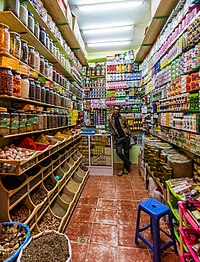
Retail is the auction of goods and services to consumers, in contrast to wholesaling, which is sale to business or institutional customers. A retailer purchases goods in large quantities from manufacturers, directly or through a wholesaler, and then sells in smaller quantities to consumers for a profit. Retailers are the concluding link in the supply chain from producers to consumers. Shopping generally refers to the deed of buying products. Sometimes this is done to obtain final goods, including necessities such as food and habiliment; sometimes it takes identify every bit a recreational activity. Recreational shopping often involves window shopping and browsing: it does not ever consequence in a purchase.
Retail markets and shops accept a very ancient history, dating back to antiquity. Some of the earliest retailers were itinerant peddlers. Over the centuries, retail shops were transformed from little more than "rude booths" to the sophisticated shopping malls of the modern era.
Well-nigh modern retailers typically make a variety of strategic level decisions including the type of store, the market to be served, the optimal product array, client service, supporting services and the store's overall market positioning. Once the strategic retail plan is in identify, retailers devise the retail mix which includes product, price, place, promotion, personnel, and presentation. In the digital historic period, an increasing number of retailers are seeking to reach broader markets by selling through multiple channels, including both bricks and mortar and online retailing. Digital technologies are as well changing the way that consumers pay for appurtenances and services. Retailing support services may as well include the provision of credit, commitment services, informational services, stylist services and a range of other supporting services.
Retail shops occur in a various range of types and in many dissimilar contexts – from strip shopping centres in residential streets through to large, indoor shopping malls. Shopping streets may restrict traffic to pedestrians simply. Sometimes a shopping street has a partial or full roof to create a more than comfy shopping environment – protecting customers from various types of weather condition conditions such as extreme temperatures, winds or precipitation.[ relevant? ] Forms of non-shop retailing include online retailing (a type of electronic-commerce used for business-to-consumer (B2C) transactions) and postal service order.
Etymology [edit]
The give-and-take retail comes from the Former French verb tailler, meaning "to cut off, prune, pare, divide in terms of tailoring" (c. 1365). Information technology was get-go recorded as a noun in 1433 with the pregnant of "a sale in modest quantities" from the Heart French verb retailler meaning "a slice cut off, shred, fleck, paring".[1] At the present, the meaning of the give-and-take retail (in English, French, Dutch, German language and Spanish) refers to the auction of small quantities of items to consumers (as opposed to wholesale).
Definition and explanation [edit]
Retail refers to the activity of selling goods or services direct to consumers or end-users.[2] Some retailers may sell to business concern customers, and such sales are termed non-retail activity. In some jurisdictions or regions, legal definitions of retail specify that at least fourscore pct of sales activity must be to end-users.[3]
Retailing often occurs in retail stores or service establishments, just may too occur through direct selling such as through vending machines, door-to-door sales or electronic channels.[iv] Although the thought of retail is ofttimes associated with the buy of goods, the term may exist applied to service providers that sell to consumers. Retail service providers include retail banking, tourism, insurance, private healthcare, individual education, private security firms, legal firms, publishers, public transport, and others. For example, a tourism provider might have a retail division that books travel and accommodation for consumers plus a wholesale division that purchases blocks of adaptation, hospitality, transport, and sightseeing which are afterwards packaged into a holiday tour for auction to retail travel agents.
Some retailers badge their stores as "wholesale outlets" offering "wholesale prices." While this practice may encourage consumers to imagine that they have access to lower prices, while being prepared to trade-off reduced prices for cramped in-store environments, in a strictly legal sense, a shop that sells the majority of its merchandise direct to consumers, is defined every bit a retailer rather than a wholesaler. Unlike jurisdictions gear up parameters for the ratio of consumer to business concern sales that define a retail business organisation.
History [edit]

Marketplace at Trajan's Forum, the earliest known example of permanent retail shopfronts

Chiliad Bazaar, Istanbul (interior). Established in 1455, information technology is thought to be the oldest continuously operating covered marketplace
Retail markets have existed since ancient times. Archaeological evidence for trade, probably involving barter systems, dates dorsum more than than ten,000 years. As civilizations grew, barter was replaced with retail trade involving coinage. Selling and buying are idea to have emerged in Asia Small (mod Turkey) in around the 7th-millennium BCE.[5] In ancient Greece, markets operated within the agora, an open space where, on market days, goods were displayed on mats or temporary stalls.[6] In aboriginal Rome, merchandise took place in the forum.[seven] The Roman forum was arguably the earliest instance of a permanent retail shop-front.[viii] Recent inquiry suggests that China exhibited a rich history of early retail systems.[nine] From as early as 200 BCE, Chinese packaging and branding were used to signal family, place names and production quality, and the use of government imposed product branding was used betwixt 600 and 900 CE.[10] Eckhart and Bengtsson have argued that during the Song Dynasty (960–1127), Chinese society developed a consumerist civilisation, where a high level of consumption was attainable for a broad variety of ordinary consumers rather than just the elite.[11] In Medieval England and Europe, relatively few permanent shops were to be constitute; instead, customers walked into the tradesman's workshops where they discussed purchasing options straight with tradesmen.[12] In the more populous cities, a pocket-size number of shops were beginning to emerge past the 13th century.[13] Exterior the major cities, most consumable purchases were fabricated through markets or fairs.[xiv] Market-places appear to accept emerged independently exterior Europe. The M Bazaar in Istanbul is often cited as the earth'due south oldest continuously operating market; its construction began in 1455. The Castilian conquistadors wrote glowingly of markets in the Americas. In the 15th century, the Mexica (Aztec) market of Tlatelolco was the largest in all the Americas.[15]

The retail service counter was an innovation of the eighteenth century
By the 17th century, permanent shops with more regular trading hours were beginning to supercede markets and fairs as the main retail outlet. Provincial shopkeepers were active in almost every English market place boondocks.[16] As the number of shops grew, they underwent a transformation. The trappings of a modern shop, which had been entirely absent from the sixteenth- and early seventeenth-century shop, gradually made fashion for shop interiors and shopfronts that are more familiar to modernistic shoppers. Prior to the eighteenth century, the typical retail store had no counter, brandish cases, chairs, mirrors, changing rooms, etc. However, the opportunity for the client to scan merchandise, touch and feel products began to be bachelor, with retail innovations from the late 17th and early 18th centuries.[17]

Galeries de bois at au Palais-Majestic, one of the earliest shopping arcades in Europe
By the late eighteenth century, grand shopping arcades began to emerge across Europe and in the Antipodes. A shopping arcade refers to a multiple-vendor infinite, operating nether a covered roof. Typically, the roof was constructed of glass to allow for natural light and to reduce the need for candles or electric lighting. Some of the earliest examples of shopping arcade appeared in Paris, due to its lack of pavement for pedestrians.[18] While the arcades were the province of the bourgeoisie, a new type of retail venture emerged to serve the needs of the working poor. John Stuart Manufactory wrote about the ascent of the co-operative retail shop, which he witnessed outset-hand in the mid-nineteenth century.[19]
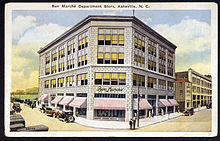
Department stores, such equally Le Bon Marché of France, appeared from the mid nineteenth century
The modern era of retailing is divers as the period from the industrial revolution to the 21st century.[20] In major cities, the department shop emerged in the mid- to tardily 19th century, and permanently reshaped shopping habits, and redefined concepts of service and luxury.[21] Many of the early department stores were more than only a retail emporium; rather they were venues where shoppers could spend their leisure time and be entertained.[22] Retail, using mail order, came of age during the mid-19th century. Although catalogue sales had been used since the 15th century, this method of retailing was confined to a few industries such every bit the auction of books and seeds. However, improvements in transport and postal services led several entrepreneurs on either side of the Atlantic to experiment with catalogue sales.[23]
In the post-state of war period, an American architect, Victor Gruen adult a concept for a shopping mall; a planned, cocky-contained shopping complex complete with an indoor plaza, statues, planting schemes, piped music, and motorcar-parking. Gruen's vision was to create a shopping atmosphere where people felt so comfortable, they would spend more fourth dimension in the environment, thereby enhancing opportunities for purchasing. The first of these malls opened at Northland Mall near Detroit in 1954.[24] Throughout the twentieth century, a tendency towards larger store footprints became discernible. The boilerplate size of a U.S. supermarket grew from 31,000 square feet (ii,900 mtwo) square feet in 1991 to 44,000 square feet (4,100 m2) square anxiety in 2000.[25] Past the end of the twentieth century, stores were using labels such as "mega-stores" and "warehouse" stores to reflect their growing size.[26] The upward trend of increasing retail space was not consistent across nations and led in the early 21st century to a 2-fold deviation in square footage per capita between the United States and Europe.[27]
Equally the 21st century takes shape, some indications advise that large retail stores have come under increasing pressure from online sales models and that reductions in store size are evident.[28] Under such competition and other issues such as business debt,[29] at that place has been a noted business disruption called the retail apocalypse in recent years which several retail businesses, specially in North America, are sharply reducing their number of stores, or going out of business entirely.
Retail strategy [edit]

Retailers brand many strategic decisions – store blazon, market served, product assortment and client services
The distinction between "strategic" and "managerial" decision-making is commonly used to distinguish "two phases having different goals and based on different conceptual tools. Strategic planning concerns the choice of policies aiming at improving the competitive position of the house, taking business relationship of challenges and opportunities proposed by the competitive surroundings. On the other hand, managerial decision-making is focused on the implementation of specific targets."[thirty]
In retailing, the strategic plan is designed to fix out the vision and provide guidance for retail decision-makers and provide an outline of how the production and service mix volition optimize client satisfaction. As part of the strategic planning procedure, it is customary for strategic planners to bear out a detailed environmental scan which seeks to identify trends and opportunities in the competitive environment, market surround, economic environment and statutory-political environs. The retail strategy is commonly devised or reviewed every 3– v years by the chief executive officer.
The strategic retail analysis typically includes following elements:[31]

The retailer also considers the overall strategic position and retail epitome
- Marketplace analysis – Market size, stage of market, marketplace competitiveness, market place attractiveness, market trends
- Customer assay – Market place segmentation, demographic, geographic and psychographic profile, values and attitudes, shopping habits, brand preferences, analysis of needs and wants, media habits
- Internal analysis – Other capabilities due east.m. human resource capability, technological capability, financial adequacy, ability to generate scale economies or economies of scope, trade relations, reputation, positioning, past performance
- Competition assay – Availability of substitutes, competitor's strengths and weaknesses, perceptual mapping, competitive trends
- Review of product mix – :: Sales per foursquare foot, stock-turnover rates, profitability per production line
- Review of distribution channels – Atomic number 82-times betwixt placing order and delivery, cost of distribution, toll efficiency of intermediaries
- Evaluation of the economics of the strategy – Price-do good analysis of planned activities
At the conclusion of the retail assay, retail marketers should have a clear thought of which groups of customers are to be the target of marketing activities. Not all elements are, however, equal, often with demographics, shopping motivations, and spending directing consumer activities.[32] Retail inquiry studies suggest that there is a stiff relationship between a store's positioning and the socio-economic status of customers.[33] In add-on, the retail strategy, including service quality, has a significant and positive association with customer loyalty.[34] A marketing strategy effectively outlines all key aspects of firms' targeted audience, demographics, preferences. In a highly competitive market, the retail strategy sets up long-term sustainability. It focuses on customer relationships, stressing the importance of added value, customer satisfaction and highlights how the store'south market place positioning appeals to targeted groups of customers.[35]
Retail marketing [edit]

The retail marketing mix or the 6 Ps of retailing
In one case the strategic plan is in place, retail managers turn to the more managerial aspects of planning. A retail mix is devised for the purpose of coordinating day-to-day tactical decisions. The retail marketing mix typically consists of six broad decision layers including product decisions, place decisions, promotion, toll, personnel and presentation (also known as physical evidence). The retail mix is loosely based on the marketing mix, only has been expanded and modified in line with the unique needs of the retail context. A number of scholars have argued for an expanded marketing, mix with the inclusion of 2 new Ps, namely, Personnel and Presentation since these contribute to the customer's unique retail experience and are the primary basis for retail differentiation. Withal other scholars fence that the Retail Format (i.e. retail formula) should be included.[36] The modified retail marketing mix that is most normally cited in textbooks is often chosen the vi Ps of retailing (see diagram at correct).[37] [38]
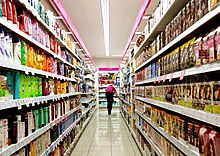
A typical supermarket carries an assortment of between thirty,000 and 60,000 different products
The primary production-related decisions facing the retailer are the product assortment (what product lines, how many lines and which brands to carry); the type of client service (loftier contact through to cocky-service) and the availability of support services (e.g. credit terms, delivery services, after sales care). These decisions depend on conscientious analysis of the market place, need, competition as well as the retailer's skills and expertise.
Customer service is the "sum of acts and elements that allow consumers to receive what they need or desire from [the] retail establishment." Retailers must make up one's mind whether to provide a full service outlet or minimal service outlet, such as no-service in the case of vending machines; self-service with only basic sales help or a full service functioning as in many boutiques and speciality stores. In addition, the retailer needs to make decisions about sales support such as customer delivery and after sales customer care.

Sellers of souvenirs are typically located in loftier traffic areas such every bit this London souvenir stand situated nearly a railway station on a busy street corner
Identify decisions are primarily concerned with consumer admission and may involve location, space utilisation and operating hours. Retailers may consider a range of both qualitative and quantitative factors to evaluate to potential sites nether consideration. Macro factors include market characteristics (demographic, economic and socio-cultural), demand, contest and infrastructure (e.chiliad. the availability of power, roads, public send systems). Micro factors include the size of the site (eastward.thousand. availability of parking), admission for commitment vehicles. A major retail trend has been the shift to multi-aqueduct retailing. To counter the disruption caused by online retail, many bricks and mortar retailers have entered the online retail space, by setting up online catalogue sales and due east-commerce websites. However, many retailers accept noticed that consumers behave differently when shopping online. For instance, in terms of pick of online platform, shoppers tend to choose the online site of their preferred retailer initially, but as they proceeds more experience in online shopping, they become less loyal and more than likely to switch to other retail sites.[39] Online stores are usually available 24 hours a solar day, and many consumers across the globe have Internet admission both at piece of work and at home.

Extensive use of the terminal digit 'ix' suggests that psychological pricing is at play
The broad pricing strategy is normally established in the visitor's overall strategic plan. In the instance of chain stores, the pricing strategy would be fix by head office. Broadly, there are six approaches to pricing strategy mentioned in the marketing literature: operations-oriented,[40] revenue-oriented,[40] customer-oriented,[forty] value-based,[41] [42] relationship-oriented,[43] and socially-oriented.[44] When determination-makers have determined the broad arroyo to pricing (i.eastward., the pricing strategy), they plow their attention to pricing tactics. Tactical pricing decisions are shorter term prices, designed to accomplish specific short-term goals. Pricing tactics that are ordinarily used in retail include discount pricing,[45] everyday depression prices,[46] high-depression pricing,[46] [47] loss leaders, product bundling,[48] promotional pricing, and psychological pricing.[49] Retailers must as well plan for client preferred payment modes – due east.grand. cash, credit, lay-by, Electronic Funds Transfer at Point-of-Sale (EFTPOS). All payment options require some type of handling and attract costs.[fifty] Opposite to mutual misconception, price is not the most important factor for consumers, when deciding to buy a product.[51]

One of the almost well-known cantankerous-selling sales scripts comes from McDonald's. "Would you lot like fries with that?"
Considering patronage at a retail outlet varies, flexibility in scheduling is desirable. Employee scheduling software is sold, which, using known patterns of client patronage, more or less reliably predicts the need for staffing for various functions at times of the year, day of the month or calendar week, and time of day. Usually needs vary widely. Conforming staff utilization to staffing needs requires a flexible workforce which is available when needed but does not have to be paid when they are not, part-fourth dimension workers; as of 2012 lxx% of retail workers in the Us were part-time. This may result in fiscal problems for the workers, who while they are required to be available at all times if their work hours are to be maximized, may not have sufficient income to meet their family and other obligations.[52] Retailers can apply unlike techniques to enhance sales volume and to better the client experience, such every bit Improver, Upsell or Cross-sell; Selling on value;[53] and knowing when to shut the auction.[54]
Transactional marketing aims to find target consumers, then negotiate, trade, and finally end relationships to consummate the transaction. In this one-time transaction process, both parties aim to maximize their own interests. As a result, transactional marketing raises follow-up problems such every bit poor later-sales service quality and a lack of feedback channels for both parties. In addition, because retail enterprises needed to redevelop client relationships for each transaction, marketing costs were loftier and client retention was low. All these downsides to transactional marketing gradually pushed the retail industry towards establishing long-term cooperative relationships with customers. Through this lens, enterprises began to focus on the process from transaction to relationship.[55] While expanding the sales market and attracting new customers is very of import for the retail industry, it is also important to constitute and maintain long term good relationships with previous customers, hence the proper name of the underlying concept, "relational marketing". Under this concept, retail enterprises value and attempt to amend relationships with customers, as customer relationships are conducive to maintaining stability in the current competitive retail marketplace, and are also the future of retail enterprises.
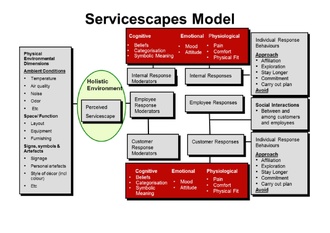
Simplified servicescapes model

Modern technologies are often displayed in clean environments with much empty space.

The retail servicescape includes the appearance, equipment, display infinite, retail counters, signage, layout and functionality of a retail outlet. Pictured: Harrods food courtroom
Presentation refers to the physical evidence that signals the retail image. Physical evidence may include a diverse range of elements – the store itself including premises, offices, exterior facade and interior layout, websites, delivery vans, warehouses, staff uniforms. The surroundings in which the retail service encounter occurs is sometimes known as the retail servicescape. [56] The store environment consists of many elements such as smells, the concrete environment (furnishings, layout and functionality), ambient conditions (lighting, temperature, dissonance) also as signs, symbols and artifacts (due east.m. sales promotions, shelf space, sample stations, visual communications). Retail designers pay close attention to the forepart of the shop, which is known as the decompression zone. In gild to maximise the number of selling opportunities, retailers mostly desire customers to spend more time in a retail shop. Nevertheless, this must be counterbalanced against customer expectations surrounding convenience, access and realistic waiting times.[57] The style that brands are displayed is also part of the overall retail design. Where a product is placed on the shelves has implications for purchase likelihood equally a outcome of visibility and access.[58] Ambient conditions, such as lighting, temperature and music, are also office of the overall retail surround.[59] It is common for a retail store to play music that relates to their target market place.[sixty]
Shopper profiles [edit]
Two different strands of research accept investigated shopper behaviour. One strand is primarily concerned with shopper motivations. Another stream of inquiry seeks to segment shoppers according to mutual, shared characteristics. To some extent, these streams of research are inter-related, but each stream offers different types of insights into shopper behaviour.

People who store for pleasance are known every bit recreational shoppers. The recreational shopper has its origins in the k European shopping arcades. Pictured: The gentry in a Dutch lace store in the 17th century
Babin et al. carried out some of the primeval investigations into shopper motivations and identified two broad motives: utilitarian and hedonic. Utilitarian motivations are task-related and rational. For the shopper with commonsensical motives, purchasing is a work-related task that is to exist accomplished in the nigh efficient and expedient manner. On the other hand, hedonic motives refer to pleasure. The shopper with hedonic motivations views shopping every bit a form of escapism where they are gratis to indulge fantasy and freedom. Hedonic shoppers are more than involved in the shopping experience.[61]
Many different shopper profiles can be identified. Retailers develop customised segmentation analyses for each unique outlet. All the same, it is possible to identify a number of broad shopper profiles. One of the most well-known and widely cited shopper typologies is that developed by Sproles and Kendal in the mid-1980s.[62] [63] [64] Sproles and Kendall's consumer typology has been shown to exist relatively consequent across time and across cultures.[65] [66] Their typology is based on the consumer'due south approach to making purchase decisions.[67]
- Quality conscious/Perfectionist: Quality-consciousness is characterised by a consumer's search for the very best quality in products; quality witting consumers tend to shop systematically making more comparisons and shopping around.
- Brand-conscious: Brand-consciousness is characterised by a tendency to buy expensive, well-known brands or designer labels. Those who score high on make-consciousness tend to believe that the college prices are an indicator of quality and exhibit a preference for department stores or pinnacle-tier retail outlets.
- Recreation-conscious/Hedonistic: Recreational shopping is characterised past the consumer'due south engagement in the purchase process. Those who score high on recreation-consciousness regard shopping itself as a course of enjoyment.
- Toll-conscious: A consumer who exhibits price-and-value consciousness. Price-conscious shoppers carefully shop effectually seeking lower prices, sales or discounts and are motivated by obtaining the best value for coin
- Novelty/fashion-conscious: characterised by a consumer'due south trend to seek out new products or new experiences for the sake of excitement; who gain excitement from seeking new things; they like to go along upwards-to-date with fashions and trends, variety-seeking is associated with this dimension.
- Impulsive: Impulsive consumers are somewhat devil-may-care in making buy decisions, buy on the spur of the moment and are non overly concerned with expenditure levels or obtaining value. Those who score high on impulsive dimensions tend non to be engaged with the object at either a cognitive or emotional level.
- Dislocated (by overchoice): characterised by a consumer'south confusion caused by besides many product choices, likewise many stores or an overload of product information; tend to feel information overload.
- Habitual/brand loyal: characterised by a consumer's trend to follow a routine buy design on each purchase occasion; consumers have favourite brands or stores and have formed habits in choosing; the purchase determination does not involve much evaluation or shopping effectually.
Some researchers have adjusted Sproles and Kendall'southward methodology for use in specific countries or cultural groups.[68] Consumer determination styles are important for retailers and marketers because they describe behaviours that are relatively stable over time and for this reason, they are useful for market place segmentation.
Types of retail outlets [edit]

Australia's Officeworks is a category killer, retailing everything for the dwelling house office or small-scale commercial office; stationery, article of furniture, electronics, communications devices, copying, printing and photography services, coffee, tea and light snacks

Apple's concept stores include video walls, Wi-Fi and desks to provide an immersive customer feel

A general store in Scarsdale, Victoria, Commonwealth of australia operates as a post-office, newsagent, petrol station, video hire, grocer and take-away food retailer

The retail format (as well known as the retail formula) influences the consumer'southward store selection and addresses the consumer'due south expectations. At its about bones level, a retail format is a simple market, that is; a location where goods and services are exchanged. In some parts of the earth, the retail sector is notwithstanding dominated by pocket-sized family unit-run stores, only large retail chains are increasingly dominating the sector, because they can exert considerable ownership ability and laissez passer on the savings in the course of lower prices. Many of these large retail chains as well produce their own private labels which compete alongside manufacturer brands. Considerable consolidation of retail stores has changed the retail mural, transferring power away from wholesalers and into the hands of the large retail bondage.[69] In United kingdom of great britain and northern ireland and Europe, the retail sale of goods is designated equally a service activity. The European Service Directive applies to all retail trade including periodic markets, street traders and peddlers.
Retail stores may exist classified by the type of product carried. Softline retailers sell appurtenances that are consumed subsequently a unmarried-use, or have a limited life (typically nether 3 years) in they are unremarkably consumed. Soft appurtenances include clothing, other fabrics, footwear, toiletries, cosmetics, medicines and stationery.[lxx] [71] Grocery stores, including supermarkets and hypermarkets, along with convenience stores carry a mix of food products and consumable household items such as detergents, cleansers, personal hygiene products. Retailers selling consumer durables are sometimes known every bit hardline retailers [72] – automobiles, appliances, electronics, furniture, sporting appurtenances, lumber, etc., and parts for them. Specialist retailers operate in many industries such as the arts east.thousand. greenish grocers, gimmicky art galleries, bookstores, handicrafts, musical instruments, gift shops.
Types of retail outlets past marketing strategy include shopping arcade, anchor store,[73] bazaar, boutique,[74] category killer,[75] [76] chain store,[77] co-operative shop[78] convenience store,[79] department stores,[80] disbelieve stores,[81] e-tailer,[82] full general store,[83] give-abroad shop,[84] hawkers also known as peddlers, costermongers or street vendors,[85] high street store,[86] hypermarket,[87] pop-upward retail,[88] market place,[89] market foursquare, shopping center,[90] [91] speciality store,[92] [93] supermarket[94] variety stores,[95] vending car,[96] no frills, warehouse clubs,[97] warehouse stores,[98] automatic retail, big-box stores, second-mitt shop, and charity shop. Retailers can opt for a format every bit each provides different retail mix to its customers based on their client demographics, lifestyle and buy behavior. An constructive format volition determine how products are display products, as well equally how target customers are attracted.
Challenges [edit]
To achieve and maintain a foothold in an existing market, a prospective retail institution must overcome the post-obit hurdles:
- regulatory barriers including:
- restrictions on real-estate purchases, especially equally imposed by local governments and against "big-box" chain retailers
- restrictions on strange investment in retailers, in terms of both absolute amount of financing provided and pct share of voting stock (eastward.g. common stock) purchased
- unfavorable taxation structures, specially those designed to penalize or go on out "big box" retailers (come across "Regulatory" above)
- absenteeism of developed supply-chain and integrated IT management
- high competitiveness among existing marketplace participants and resulting low profit margins, caused in office past:
- abiding advances in product design resulting in constant threat of production obsolescence and toll declines for existing inventory
- lack of a properly-educated and/or -trained work-force, often including management, caused in part by loss in business[ clarification needed ]
- lack of educational infrastructure enabling prospective market place entrants to respond to the above challenges
- direct e-tailing (for instance, through the Internet) and direct commitment to consumers from manufacturers and suppliers, cutting out whatsoever retail heart man.[99]
Consolidation [edit]
Among retailers and retails chains a lot of consolidation has appeared over the last couple of decades. Between 1988 and 2010, worldwide 40,788 mergers & acquisitions with a total known value of Us$2.255 trillion have been announced.[100] The largest transactions with involvement of retailers in/from the United States have been: the acquisition of Albertson's Inc. for US$17 billion in 2006,[101] the merger between Federated Section Stores Inc with May Department Stores valued at 16.five bil. USD in 2005[102] – now Macy'due south, and the merger betwixt Kmart Belongings Corp and Sears Roebuck & Co with a value of US$10.9 billion in 2004.[103]
Between 1985 and 2018 there have been 46,755 mergers or acquisitions conducted globally in the retail sector (either acquirer or target from the retail manufacture). These deals cumulate to an overall known value of around United states of america$2,561 billion. The 3 major Retail Chiliad&A waves took place in 2000, 2007 and lately in 2017. However the all-time high in terms of number of deals was in 2016 with more than 2,700 deals. In terms of added value 2007 set the record with the U.s.a.$225 billion.[104]
Here is a list of the peak ten largest deals (ranked by volume) in the Retail Manufacture:[ commendation needed ]
| Engagement Appear | Acquiror Name | Acquiror Mid Manufacture | Acquiror Nation | Target Name | Target Mid Industry | Target Nation | Value of Transaction ($mil) |
| xi/01/2006 | CVS Corp | Other Retailing | United States | Caremark Rx Inc | Healthcare Providers & Services (HMOs) | United States | 26,293.58 |
| 03/09/2007 | AB Acquisitions Ltd | Other Financials | United Kingdom | Alliance Boots PLC | Other Retailing | United kingdom of great britain and northern ireland | 19,604.xix |
| 12/18/2000 | Shareholders | Other Financials | United Kingdom | Granada Compass-Hospitality | Food & Beverage Retailing | U.k. | 17,914.68 |
| 01/20/2006 | AB Acquisition LLC | Other Financials | United states of america | Albertsons Inc | Food & Beverage Retailing | United States | 17,543.85 |
| 02/26/2013 | Habitation Depot Inc | Home Improvement Retailing | United States | Home Depot Inc | Home Improvement Retailing | Us | 17,000.00 |
| 02/28/2005 | Federated Section Stores | Discount and Department Shop Retailing | United States | May Department Stores Co | Non Residential | United States | 16,465.87 |
| 08/30/1999 | Carrefour SA | Food & Drinkable Retailing | France | Promodes | Food & Beverage Retailing | French republic | 15,837.48 |
| 06/19/2012 | Walgreen Co | Other Retailing | United states | Alliance Boots GmbH | Other Retailing | Switzerland | 15,292.48 |
| 07/02/2007 | Wesfarmers Ltd | Food & Beverage Retailing | Australia | Coles Group Ltd | Nutrient & Beverage Retailing | Australia | 15,287.79 |
| 06/03/2011 | Wal-Mart Stores Inc | Discount and Section Shop Retailing | United States | Wal-Mart Stores Inc | Disbelieve and Department Store Retailing | U.s.a. | xiv,288.00 |
Statistics [edit]
Global height 10 retailers [edit]
As of 2016, China was the largest retail market in the world.[105]
| Worldwide top ten retailers[106] | |||||
|---|---|---|---|---|---|
| Rank | Company | Headquarters | 2020 full revenue (US$ billion)[106] | Business concern foundation | Number of countries of operation 2020 |
| 1 | Walmart |  United States United States | $519.93 | Hypermarket/supercenter/superstore | 27 |
| 2 | Amazon | Us | $280.52 | Ecommerce | eighteen |
| three | Costco | United States | $163.22 | Cash & deport/warehouse club | 12 |
| four | Schwarz Gruppe (Lidl) |  Germany Germany | $133.89 | Discount grocery store | 33 |
| 5 | Aldi | Federal republic of germany | $116.06 | Disbelieve grocery shop | 18 |
| half-dozen | JD.com |  China China | $82.86 | Ecommerce | - |
| 7 | Carrefour |  France France | $82.60 | Hypermarket/supermarket | 32 |
| eight | Ahold Delhaize |  Netherlands Netherlands | $78.17 | Grocery store | 10 |
| ix | Alibaba | China | $71.99 | Ecommerce | 7 |
| 10 | IKEA | Netherlands | $45.18 | Piece of furniture | 60 |
Competition [edit]
Retail stores may or may not have competitors shut enough to affect their pricing, product availability, and other operations. A 2006 survey institute that only 38% of retail stores in Republic of india believed they faced more than than slight contest.[107] Competition too affected less than half of retail stores in Kazakhstan, Bulgaria, and Azerbaijan. In all countries the chief competition was domestic, not foreign.[108]
| State | % of retail stores facing competition[108] |
|---|---|
| Republic of india | 38% |
| Kazakhstan | 44% |
| Bulgaria | 46% |
| Azerbaijan | 48% |
| Uzbekistan | 58% |
| Armenia | 58% |
| Georgia | 59% |
| Kyrgyz republic | 59% |
| Russia | 62% |
| Belarus | 64% |
| Croatia | 68% |
| Romania | 68% |
| Ukraine | 72% |
| Turkey | 73% |
| Serbia | 74% |
| Tajikistan | 74% |
| Slovenia | 77% |
| Latvia | 78% |
| Bosnia and herzegovina | 79% |
| Moldova | 79% |
| Czech Republic | eighty% |
| Slovakia | 80% |
| Poland | 83% |
| Hungary | 87% |
| Estonia | 88% |
| Lithuania | 88% |
| Republic of macedonia | 88% |
| Republic of albania | 89% |
Retail trade provides ix% of all jobs in India and 14% of Gross domestic product.[107]
Statistics for national retail sales [edit]

U.S. Monthly Retail Sales, 1992–2010
Us [edit]
The National Retail Federation and Kantar annually rank the nation's meridian retailers according to sales.[109] The National Retail Federation also separately ranks the 100 fastest-growing U.Southward. retailers based on increases in domestic sales.[110] [111]
Since 1951, the U.S. Demography Agency has published the Retail Sales written report every month. It is a measure of consumer spending, an important indicator of the US GDP. Retail firms provide information on the dollar value of their retail sales and inventories. A sample of 12,000 firms is included in the final survey and v,000 in the advanced one. The advanced estimated information is based on a subsample from the US CB complete retail & food services sample.[112]
Retail is the largest private-sector employer in the United states of america, supporting 52 million working Americans.[113]
Primal Europe [edit]
In 2011, the grocery market in six countries of Key Europe was worth virtually €107bn, 2.8% more than the previous year when expressed in local currencies. The increase was generated foremost past the discount stores and supermarket segments, and was driven by the skyrocketing prices of foodstuffs. This information is based on the latest PMR report entitled Grocery retail in Key Europe 2012[114]
World [edit]

Nippon has the largest number of vending machines per capita.
National accounts show a combined full of retail and wholesale trade, with hotels and restaurants. in 2012 the sector provides over a fifth of Gdp in tourist-oriented island economies, as well as in other major countries such as Brazil, Pakistan, Russia, and Spain. In all four of the latter countries, this fraction is an increment over 1970, but in that location are other countries where the sector has declined since 1970, sometimes in accented terms, where other sectors have replaced its role in the economic system. In the U.s.a. the sector has declined from 19% of Gdp to 14%, though information technology has risen in accented terms from $four,500 to $7,400 per capita per year. In Cathay the sector has grown from seven.3% to 11.5%, and in India even more, from 8.four% to 18.vii%. Emarketer predicts China will have the largest retail market in the world in 2016.[115]
In 2016, China became the largest retail market in the world.[105]
| Economy | As % of Gdp, 1970 | As % of Gdp, 2012 | 1970 value per capita (2012 prices) | 2012 value per capita |
|---|---|---|---|---|
| Afghanistan | 13.one | 8.four | $140 | $58 |
| Albania | 11.v | 22.5 | $188 | $858 |
| Algeria | 17.3 | xi.nine | $572 | $639 |
| Andorra | 40.5 | 26.5 | $17,532 | $10,915 |
| Angola | 12.6 | fifteen.0 | $513 | $839 |
| Anguilla | 33.9 | 27.8 | $2,166 | $v,577 |
| Antigua and Barbuda | 26.four | 26.eight | $1,081 | $three,540 |
| Argentine republic | 15.four | xv.seven | $1,041 | $1,825 |
| Armenia | 15.2 | $510 | ||
| Aruba | 26.9 | 19.ane | $1,140 | $4,757 |
| Australia | eleven.iv | 11.7 | $3,736 | $seven,960 |
| Austria | 17.4 | 18.viii | $3,281 | $8,782 |
| Republic of azerbaijan | 9.0 | $668 | ||
| Bahamas | 28.0 | 24.v | $5,335 | $five,299 |
| Bahrain | 12.v | half-dozen.4 | $3,046 | $i,478 |
| People's republic of bangladesh | 15.9 | 15.1 | $61 | $124 |
| Barbados | 26.ane | 24.three | $two,879 | $3,890 |
| Belarus | 16.8 | $1,127 | ||
| Belgium | 12.ix | 14.2 | $2,606 | $6,189 |
| Belize | 17.0 | 20.3 | $297 | $972 |
| Republic of benin | 17.vii | 17.4 | $89 | $131 |
| Bermuda | 17.6 | 11.2 | $8,907 | $9,648 |
| Bhutan | 8.2 | 8.2 | $30 | $205 |
| Republic of bolivia | ix.1 | 11.1 | $168 | $286 |
| Bosnia and Herzegovina | 17.9 | $807 | ||
| Republic of botswana | 9.2 | 16.viii | $60 | $i,206 |
| Brazil | 16.4 | 21.3 | $756 | $2,413 |
| British Virgin Islands | 19.7 | 27.2 | $2,178 | $viii,821 |
| Brunei Darussalam | ane.0 | 3.7 | $495 | $1,536 |
| Bulgaria | 14.six | 13.8 | $272 | $966 |
| Burkina Faso | xiv.9 | 14.2 | $46 | $92 |
| Burundi | 8.i | 18.9 | $16 | $43 |
| Cambodia | xvi.6 | 14.v | $86 | $137 |
| Cameroon | 27.0 | 20.4 | $270 | $245 |
| Canada | 13.6 | xiii.0 | $iii,586 | $vi,788 |
| Greatcoat Verde | 24.v | xviii.7 | $269 | $718 |
| Cayman Islands | 12.0 | 12.2 | $three,544 | $7,175 |
| Cardinal African Republic | 14.0 | 13.5 | $100 | $65 |
| Chad | 20.5 | 12.6 | $122 | $103 |
| Chile | xiv.ix | 11.7 | $780 | $1,801 |
| China | vii.3 | xi.5 | $twenty | $700 |
| China: Hong Kong SAR | 19.1 | 29.3 | $1,197 | $10,772 |
| Cathay: Macao SAR | viii.0 | xiv.9 | $592 | $11,629 |
| Colombia | 13.0 | 12.4 | $439 | $959 |
| Union of the comoros | 26.ii | 14.5 | $232 | $125 |
| Congo | xiii.ii | 5.4 | $256 | $185 |
| Cook Islands | 13.7 | 39.6 | $one,069 | $five,912 |
| Costa rica | 19.9 | sixteen.three | $805 | $i,531 |
| Republic of croatia | xv.iv | $2,012 | ||
| Cuba | 18.4 | xv.2 | $432 | $959 |
| Cyprus | thirteen.6 | xviii.eight | $958 | $4,975 |
| Czech Republic | 13.two | $2,429 | ||
| Czechoslovakia (Former) | 8.0 | $127 | ||
| Democratic Republic of North korea | 11.7 | xviii.3 | $231 | $107 |
| Democratic Republic of the Congo | ||||
| Denmark | 20.v | fifteen.5 | $6,169 | $8,708 |
| Djibouti | 45.0 | 18.vi | $1,470 | $294 |
| Dominica | ix.vi | 15.0 | $163 | $ane,046 |
| Dominican Commonwealth | 17.2 | 18.7 | $270 | $1,073 |
| Republic of ecuador | eight.3 | 12.6 | $195 | $713 |
| Egypt | 11.0 | xiv.iv | $75 | $454 |
| El Salvador | 22.6 | 21.two | $534 | $804 |
| Equatorial guinea | 6.4 | 0.9 | $56 | $185 |
| Eritrea | 19.4 | $98 | ||
| Estonia | 14.0 | $ii,432 | ||
| Ethiopia | 18.6 | $84 | ||
| Ethiopia (Former) | 8.4 | |||
| Republic of the fiji islands | 8.3 | eighteen.half-dozen | $216 | $848 |
| Finland | 12.iii | thirteen.3 | $2,268 | $6,103 |
| France | 14.8 | 15.0 | $2,969 | $5,933 |
| French Polynesia | 14.seven | 16.1 | $two,142 | $four,212 |
| Gabon | 28.1 | 12.1 | $ii,918 | $1,787 |
| Gambia | 27.1 | 28.8 | $143 | $147 |
| Georgia | eighteen.9 | $685 | ||
| Germany | 12.2 | 11.4 | $2,273 | $four,736 |
| Ghana | 5.3 | 10.9 | $58 | $175 |
| Greece | nineteen.half-dozen | 20.ii | $2,469 | $4,527 |
| Greenland | 14.0 | 10.5 | $two,219 | $4,326 |
| Grenada | xviii.2 | 12.three | $294 | $913 |
| Guatemala | 17.5 | 21.6 | $385 | $720 |
| Guinea | 34.0 | 16.two | $132 | $86 |
| Guinea-Bissau | 20.7 | 19.4 | $124 | $99 |
| Republic of guyana | 18.ix | fifteen.1 | $388 | $543 |
| Haiti | 17.iv | 18.4 | $168 | $130 |
| Honduras | 17.2 | 17.1 | $247 | $399 |
| Hungary | 9.8 | 14.1 | $531 | $1,760 |
| Iceland | 11.3 | eleven.0 | $1,873 | $4,585 |
| Bharat | 8.4 | xviii.7 | $31 | $283 |
| Republic of indonesia | 17.7 | 13.9 | $120 | $494 |
| Iran (Islamic Republic of) | 10.6 | 11.6 | $473 | $834 |
| Iraq | 8.ii | half dozen.4 | $215 | $290 |
| Republic of ireland | 17.six | 18.0 | $2,293 | $8,295 |
| Israel | 9.8 | 10.0 | $1,346 | $iii,145 |
| Italy | 16.0 | xv.0 | $two,755 | $4,963 |
| Cote d'ivoire | 21.7 | 14.7 | $353 | $181 |
| Jamaica | 19.4 | 22.iv | $1,056 | $1,197 |
| Japan | 15.6 | 13.nine | $iii,004 | $six,525 |
| Jordan | 17.nine | 10.1 | $478 | $445 |
| Kazakhstan | 16.viii | $2,086 | ||
| Kenya | 6.8 | thirteen.2 | $49 | $125 |
| Kiribati | 12.4 | 8.6 | $439 | $150 |
| Kosovo | 18.1 | $508 | ||
| State of kuwait | 8.3 | 3.2 | $13,693 | $1,797 |
| Kyrgyzstan | 19.7 | $233 | ||
| Laos People's DR | xiv.ii | 20.three | $44 | $278 |
| Republic of latvia | 17.9 | $two,467 | ||
| Lebanon | 31.4 | 27.6 | $2,829 | $ii,522 |
| Lesotho | 13.0 | nine.0 | $46 | $108 |
| Liberia | 11.1 | 5.0 | $106 | $eighteen |
| Libya | 2.viii | 4.9 | $543 | $763 |
| Liechtenstein | nineteen.9 | 17.8 | $12,763 | $28,361 |
| Lithuania | 19.9 | $2,782 | ||
| Grand duchy of luxembourg | 13.8 | 13.4 | $v,010 | $fourteen,141 |
| Madagascar | 8.7 | 11.0 | $seventy | $49 |
| Malawi | 3.7 | 19.viii | $10 | $70 |
| Malaysia | 12.four | 16.five | $229 | $1,716 |
| Maldives | 29.viii | thirty.8 | $252 | $ii,373 |
| Mali | 7.three | 16.two | $23 | $112 |
| Malta | 28.seven | 15.8 | $one,104 | $3,238 |
| Marshall Islands | 24.five | 16.i | $531 | $607 |
| Mauritania | ii.i | 7.1 | $20 | $72 |
| Mauritius | 10.0 | 19.3 | $167 | $1,782 |
| Mexico | xix.3 | 17.8 | $1,063 | $1,739 |
| Federated states of micronesia | 13.one | 15.1 | $219 | $477 |
| Monaco | 39.1 | xxx.3 | $34,091 | $46,027 |
| Mongolia | 21.iv | eleven.nine | $237 | $439 |
| Montenegro | 22.6 | $i,475 | ||
| Montserrat | xix.iv | 7.6 | $1,051 | $974 |
| Morocco | 22.5 | 12.4 | $253 | $365 |
| Mozambique | 12.seven | 17.half-dozen | $31 | $102 |
| Myanmar | 25.9 | twenty.1 | $48 | $226 |
| Namibia | eight.0 | 14.7 | $326 | $832 |
| Nauru | 14.eight | 16.8 | $7,812 | $2,014 |
| Nepal | 4.seven | 15.4 | $14 | $101 |
| Netherlands | 16.four | xv.eight | $3,702 | $7,283 |
| Netherlands Antilles | 16.4 | 18.2 | $1,417 | $3,349 |
| New Caledonia | 34.7 | thirteen.3 | $9,624 | $5,169 |
| New Zealand | 15.5 | 12.2 | $three,607 | $iv,689 |
| Nicaragua | 15.3 | sixteen.five | $352 | $289 |
| Niger | 10.6 | fourteen.ane | $71 | $56 |
| Nigeria | xiv.6 | 15.9 | $148 | $247 |
| Norway | 16.vii | 8.5 | $half-dozen,109 | $8,521 |
| Oman | 1.seven | 7.vii | $111 | $i,822 |
| Islamic republic of pakistan | eighteen.8 | 20.6 | $99 | $248 |
| Palau | 16.iii | 31.ii | $1,565 | $three,200 |
| Panama | sixteen.viii | 19.six | $497 | $1,864 |
| Papua New Guinea | thirteen.9 | 9.3 | $243 | $204 |
| Paraguay | xviii.3 | xix.nine | $304 | $771 |
| Peru | 14.ii | 18.6 | $583 | $1,271 |
| Philippines | 10.7 | 19.4 | $153 | $501 |
| Poland | 9.2 | xx.2 | $398 | $2,590 |
| Portugal | thirteen.7 | 19.half-dozen | $1,119 | $three,926 |
| Puerto Rico | 16.vii | 9.4 | $2,024 | $two,635 |
| Qatar | 5.0 | five.6 | $five,647 | $5,208 |
| Korea, Due south | 17.1 | 11.8 | $345 | $2,712 |
| Moldova | 17.8 | $367 | ||
| Romania | 3.i | 7.1 | $73 | $557 |
| Russian Federation | xx.7 | $2,934 | ||
| Rwanda | 9.9 | 15.7 | $35 | $97 |
| Saint Kitts and Nevis | 8.iv | 12.6 | $256 | $ane,800 |
| Saint Lucia | 20.6 | 23.4 | $527 | $1,707 |
| Samoa | xiv.viii | 23.6 | $312 | $851 |
| San Marino | 15.8 | 12.9 | $five,282 | $7,643 |
| São Tomé and Príncipe | 25.5 | 26.2 | $273 | $363 |
| Saudi Arabia | 4.half dozen | 8.2 | $799 | $ii,067 |
| Senegal | 22.7 | 20.4 | $218 | $207 |
| Serbia | 11.0 | $582 | ||
| Republic of seychelles | 32.7 | 29.four | $1,039 | $3,285 |
| Sierra Leone | 12.ix | 7.six | $93 | $55 |
| Singapore | 27.eight | nineteen.5 | $2,008 | $10,179 |
| Slovakia | 26.6 | $4,470 | ||
| Slovenia | 14.4 | $three,155 | ||
| Solomon Islands | ten.2 | 10.v | $121 | $193 |
| Somalia | 9.3 | x.6 | $21 | $14 |
| South Africa | 14.four | xvi.0 | $847 | $i,171 |
| South Sudan | 15.iv | $143 | ||
| Spain | fifteen.1 | 21.four | $i,956 | $half-dozen,060 |
| Sri Lanka | fourteen.5 | 20.8 | $94 | $586 |
| St. Vincent and the Grenadines | 12.6 | sixteen.5 | $231 | $1,045 |
| Land of Palestine | 16.seven | xviii.4 | $136 | $448 |
| Sudan | 16.8 | $232 | ||
| Sudan (Old) | 16.8 | $0 | ||
| Suriname | 18.3 | 23.3 | $915 | $2,183 |
| Swaziland | 15.5 | ix.viii | $197 | $306 |
| Sweden | 12.1 | 12.8 | $iii,315 | $7,056 |
| Switzerland | nineteen.nine | 17.eight | $10,641 | $14,080 |
| Syrian Arab Commonwealth | 20.4 | 22.vii | $184 | $482 |
| Tajikistan | xx.3 | $193 | ||
| Macedonia | sixteen.5 | $749 | ||
| Thailand | 24.3 | 18.0 | $239 | $i,039 |
| Timor-Leste | iv.0 | $195 | ||
| Togo | 23.v | 8.two | $195 | $49 |
| Tonga | 12.7 | 14.6 | $214 | $646 |
| Trinidad and Tobago | 18.nine | 17.1 | $1,323 | $two,966 |
| Tunisia | 11.7 | xiii.v | $147 | $558 |
| Turkey | xi.i | 16.v | $437 | $1,757 |
| Turkmenistan | 4.two | $274 | ||
| Turks and Caicos Islands | 38.2 | 38.0 | $1,557 | $8,520 |
| Tuvalu | ix.5 | 11.ii | $182 | $451 |
| Tanzania: Mainland, see too Zanzibar | 15.0 | 15.eight | $51 | $96 |
| Uganda | 11.8 | 22.iii | $50 | $133 |
| Ukraine | 17.5 | $679 | ||
| United Arab Emirates | 15.iv | 12.1 | $24,122 | $5,024 |
| United Kingdom | 15.iii | 16.5 | $2,662 | $6,490 |
| United States | 19.0 | fourteen.v | $4,488 | $7,436 |
| Uruguay | 12.ix | sixteen.5 | $810 | $2,419 |
| USSR (Old) | viii.ane | |||
| Uzbekistan | 9.9 | $178 | ||
| Vanuatu | 18.2 | 21.4 | $266 | $651 |
| Venezuela | ix.5 | xvi.4 | $ane,152 | $2,099 |
| Vietnam | 12.9 | 16.8 | $39 | $289 |
| Yemen | sixteen.3 | $224 | ||
| Yemen Arab Republic (Former) | 13.7 | |||
| Yemen Democratic (Quondam) | 21.ii | |||
| Yugoslavia (Former) | ten.4 | |||
| Republic of zambia | 12.half-dozen | xv.0 | $244 | $229 |
| Zanzibar | eighteen.2 | $119 | ||
| Republic of zimbabwe | 14.9 | 10.7 | $125 | $77 |
See as well [edit]
- Business-to-business
- B2G
- Consumer behaviour
- Department shop
- Last goods
- Gray pound
- Hanseatic League
- High Street
- History of marketing
- Similar for like
- List of department stores by country
- Point of sales
- Sales Promotion
- Retail concentration
- Retail blueprint
- Retail software
- Retailtainment
- Sales density
- Shopping
- Store manager
- Visual merchandising
- Licensed victualler
- L'Enseigne de Gersaint
- Wardrobing
- Window shopping
Types of sales person:
- Arabber
- Costermonger
- Bell-ringer (trade)
- Huckster
- Merchant
- Peddler
- Street vendor
Types of shop or shop:
- Anchor store
- Arcade
- Country shop
- Bazaar
- Large-box store
- Boutique
- Cash and comport (wholesale)
- Category killer
- Concatenation shop
- Apparel shop
- Confectionery store
- Convenience store
- Co-operative
- Consumers' co-operative
- Department store
- Discount store
- Drive-through store
- General store
- Grocery shop
- Hardware store
- Health food shop
- Hobby store
- Hypermarket
- Liquor store
- Market place (place)
- Mom and Pop
- Newsagent
- Online shopping
- Outlet store
- Pet store
- Pop-up retail
- Shopping mall
- Souk or souq
- Specialist shop
- Stand-alone store
- Specialty store
- Store-inside-a-store
- Supermarket
- Surplus store
- Survival shop
- Toy store
- Variety shop
- Warehouse club
- Warehouse shop
Influential thinkers in sales and retail:[117]
- Dale Carnegie: author and lecturer; proponent of salesmanship, public speaking and self-improvement
- E. St. Elmo Lewis: salesmen for NCR and developer of the AIDA model of selling
- William Thomas Rawleigh: founder of Rawleigh'south company with one of the largest travelling sales teams in the U.s.a.
- Harry Gordon Selfridge: founder of Uk Selfridges; redefined shopping away from essential errand to a pleasurable activeness; was noted for introducing a impact of theatre and celebrity appearances to department stores; also wrote the book, The Romance of Commerce published in 1918.
- Walter Dill Scott: psychologist and author; wrote a number of books on the psychology of selling in the early twentieth century
- Thomas J. Watson: salesman at NCR and CEO of IBM; frequently described as the "greatest American salesman"
References [edit]
- ^ Harper, Douglas. "retail". Online Etymology Dictionary . Retrieved 16 March 2008.
- ^ "retail" – via The Free Dictionary.
- ^ Pride, Westward.M., Ferrell, O.C. Lukas, B.A., Schembri, South. Niininen, O. and Cassidy, R., Marketing Principles, 3rd Asia-Pacific ed., Cengage, 2018, pp. 449–50
- ^ Pride, Due west.M., Ferrell, O.C. Lukas, B.A., Schembri, S. Niininen, O. and Cassidy, R., Marketing Principles, tertiary Asia-Pacific ed., Cengage, 2018, p. 451
- ^ Jones, Brian D.G.; Shaw, Eric H. (2006). "A History of Marketing Thought", Handbook of Marketing. Weitz, Barton A.; Wensley, Robin (eds), Sage, p. 41, ISBN 1-4129-2120-i.
- ^ Thompson, D.B., An Ancient Shopping Middle: The Athenian Agora, ASCSA, 1993 pp. 19–21
- ^ McGeough, K.M., The Romans: New Perspectives, ABC-CLIO, 2004, pp. 105–06
- ^ Coleman, P., Shopping Environments, Elsevier, Oxford, 2006, p. 28
- ^ Moore, Grand., and Reid., S., "The Birth of the Brand: 4000 years of Branding", Business History, Vol. l, 2008. pp. 419–32.
- ^ Eckhardt, G.G. and Bengtsson. A. "A Cursory History of Branding in China", Periodical of Macromarketing, Vol, 30, no. 3, 2010, pp. 210–21
- ^ Eckhardt, G.M. and Bengtsson. A. "A Brief History of Branding in Communist china", Periodical of Macromarketing, Vol, 30, no. three, 2010, p. 212
- ^ Thrupp, S.L., The Merchant Class of Medieval London, 1300–1500, pp. 7–8
- ^ Pevsner, N. and Hubbard, Eastward., The Buildings of England: Cheshire Penguin, 1978, p. 170
- ^ Gazetteer of Markets and Fairs in England and Wales to 1516, The List and Index Society, no. 32, 2003
- ^ Rebecca M. Seaman, ed. (2013). Disharmonize in the Early Americas: An Encyclopedia of the Spanish Empire'due south ... p. 375. ISBN978-1-59884-777-2.
- ^ Cox, N.C. and Dannehl, Thousand., Perceptions of Retailing in Early Modern England, Aldershot, Hampshire, Ashgate, 2007, p,. 129
- ^ Cox, N.C. and Dannehl, G., Perceptions of Retailing in Early Modern England, Aldershot, Hampshire, Ashgate, 2007, pp. 153–54
- ^ Conlin, J., Tales of Two Cities: Paris, London and the Nascency of the Modern City, Atlantic Books, 2013, Chapter ii
- ^ Manufacturing plant, J.S., Principles of a Political Economy with some of their Applications to Social Philosophy, 7th ed., London, Longman, 1909, Section IV.7.53
- ^ Reshaping Retail: Why Technology is Transforming the Industry and How to Win in the New Consumer Dr
- ^ Koot, G.M. (2011). "Shops and Shopping in Britain: from marketplace stalls to chain stores" (PDF). University of Massachusetts, Dartmouth. Archived from the original (PDF) on 6 Baronial 2019. Retrieved 29 May 2017.
- ^ Howard Moss, Thousand., Shopping equally an Entertainment Experience, Plymouth, Lexington Books, pp. 35–39
- ^ Goldstein. J., 101 Amazing Facts most Wales, Andrews, Britain, 2013
- ^ Malcolm Gladwell, The Terrazzo Jungle, The New Yorker, March xv, 2004
- ^ Byrne-Paquet, L., The Urge to Splurge: A Social History of Shopping, ECW Press, Toronto, Canada, p. 83
- ^ Johanson, Simon (2 June 2015). "Bunnings Shifts Focus every bit it Upsizes Store Network". The Age.
- ^ Wahba, Phil (15 June 2017). "The Death of Retail is Greatly Exaggerated". Fortune (Print magazine). p. 34.
- ^ Wetherell, S., "The Shopping Mall'southward Socialist Pre-History", Jacobin Magazine, four Baronial 2014
- ^ Townsend, Matt; Surane, Jenny; Orr, Emma; Cannon, Christopher (8 November 2017). "America's 'Retail Apocalypse' Is Really Just Get-go". Bloomberg. Retrieved 15 Jan 2018.
- ^ Volpato, G. and Stocchetti, A., "Erstwhile and new approaches to marketing: The quest of their epistemological roots", MPRA Paper No. 30841, 2009, p. 34
- ^ Lambda, A.J., The Art Of Retailing, McGraw-Hill, (2003), 2008, pp. 315–26
- ^ Parker, Christopher J.; Wenyu, Lu (13 May 2019). "What influences Chinese mode retail? Shopping motivations, demographics and spending". Journal of Fashion Marketing and Management. 23 (2): 158–175. doi:10.1108/JFMM-09-2017-0093. ISSN 1361-2026. S2CID 170031856.
- ^ Fill, C., Marketing Communications: Framework, Theories and Application, London, Prentice Hall, 1995, p. seventy
- ^ Yu-Jia, H. (2012). "The Moderating Effect of Brand Equity and the Mediating Issue of Marketing Mix Strategy On the Relationship Between Service Quality and Customer Loyalty ". International Journal of Organizational Innovation, 155–62.
- ^ Morschett, D., Swoboda, B. and Schramm, H., "Competitive Strategies in Retailing: An Investigation of the Applicability of Porter's Framework for Food Retailers Journal of Retailing and Consumer Services, Vol. 13, 2006, pp. 275–87
- ^ Constantinides, E., "The Marketing Mix Revisited: Towards the 21st Century Marketing", Journal of Marketing Management, Vo. 22, 2006, pp. 422-423
- ^ Berens, J.S., "The Marketing Mix, the Retailing Mix and the Utilise of Retail Strategy Continua", Proceedings of the 1983 Academy of Marketing Science (AMS), [Function of the series Developments in Marketing Science], pp. 323–27
- ^ Lamb, C.W., Hair, J.F. and McDaniel, C., MKTG 2010, Bricklayer, OH, Cengage, pp. 193–94
- ^ Verhoef, P., Kannan, P.G. and Inman, J., "From Multi-channel Retailing to Omni-channel Retailing: Introduction to the Special Event on Multi-aqueduct Retailing", Journal of Retailing, vol. 91, pp. 174–81. doi:10.1016/j.jretai.2015.02.005
- ^ a b c Dibb, Southward., Simkin, L., Pride, W.C. and Ferrell, O.C., Marketing: Concepts and Strategies, Cengage, 2013, Chapter 12
- ^ Nagle, T., Hogan, J. and Zale, J., The Strategy and Tactics of Pricing: A Guide to Growing More Profitably, Oxon, Routledge, 2016, p. one and half-dozen
- ^ Brennan, R., Canning, L. and McDowell, R., Business organisation-to-Business Marketing, 2nd ed., London, Sage, 2011, p. 331
- ^ Neumeier, M., The Make Flip: Why customers now run companies and how to turn a profit from it (Voices That Matter), 2008, p. 55
- ^ Irvin, G. (1978). Modern Cost-Benefit Methods. Macmillan. pp. 137–160. ISBN978-0-333-23208-eight.
- ^ Rao, Five.R. and Kartono, B., "Pricing Strategies and Objectives: A Cross-cultural Survey", in Handbook of Pricing Research in Marketing, Rao, Five.R. (ed), Northampton, MA, Edward Elgar, 2009, p. 15
- ^ a b Hoch, Steven J.; Drèze, Xavier; Purk, Mary East. (October 1994). "EDLP, Hi-Lo, and Margin Arithmetic" (PDF). The Journal of Marketing. 58 (4): 16–27. doi:10.1177/002224299405800402. S2CID 18134783.
- ^ Kaufmann, P., "Charade in retailer high-low pricing: A 'rule of reason' approach", Periodical of Retailing, Book 70, Consequence 2, 1994, pp. 115–1383.
- ^ Guiltnan, J.P., "The Toll Bundling of Services", Journal of Marketing, April 1987
- ^ Poundstone, W., Priceless: The Myth of Fair Value (and How to Take Reward of Information technology), New York: Hill and Wang, 2011, pp. 184–200
- ^ Barr, A., "PayPal Deepens Retail Drive in Find Payments Deal", Technology News. 22 August 2012
- ^ Romis, Rafael. "Quango Postal service: Three Ways To Crush Due east-Commerce: Busting Common Misconceptions". Forbes.
- ^ Steven Greenhouse (27 October 2012). "A Function-Fourth dimension Life, equally Hours Compress and Shift". The New York Times . Retrieved 28 October 2012.
- ^ Hee, J.M., "Stand-alone Auction of a Free Gift: Is information technology constructive to accentuate promotion value?" Social Behavior & Personality, Vol. 43, no. 10, 2015, pp. 1593–1606
- ^ Cant, One thousand.C.; van Heerden, C.H. (2008). Personal Selling. Juta Bookish. p. 176. ISBN978-0-7021-6636-v.
- ^ Monash University, Dictionary, https://business.monash.edu/marketing/marketing-dictionary/r/retail-mix
- ^ "The Impact of Retail Servicescape on Buying Behaviour", BVIMSR'south Journal of Management Research, Vol half-dozen, No. ii, 2014, pp. 10–17
- ^ Wakefield, 50.K. and Blodgett, G J., "The Effect of the Servicescape on Customers' Behavioral Intentions in Leisure Service Settings", The Journal of Services Marketing, Vol. 10, No. 6, pp. 45–61.
- ^ Hall, C.M. and Mitchell, R., Wine Marketing: A Practical Guide, pp. 182–83
- ^ Bailey, P. (2015, Apr). Marketing to the senses: A multisensory strategy to align the brand touchpoints. Admap, 2–7.
- ^ Hul, Michael G.; Dube, Laurette; Chebat, Jean-Charles (1 March 1997). "The impact of music on consumers' reactions to waiting for services". Periodical of Retailing. 73 (1): 87–104. doi:10.1016/S0022-4359(97)90016-half-dozen.
- ^ Babin, Barry J.; Darden, William R.; Griffin, Mitch (1994). "Piece of work and/or Fun: Measuring Hedonic and Utilitarian Shopping Value". Periodical of Consumer Research. twenty (4): 644. doi:10.1086/209376.
- ^ Durvasula, S., Lysonski, S. and Andrews, J.C. (1993), "Cantankerous-cultural generalizability of a calibration for profiling consumers' controlling styles", The Journal of Consumer Diplomacy, Vol. 27 No. 1, pp. 55–65
- ^ Sproles, G.B. (1985), "From perfectionism to faddism: measuring consumers' decision-making styles", in Schnittgrund, K.P. (Ed.), American Council on Consumer Interests (ACCI), Conference Proceedings, Columbia, MO, pp. 79–85.
- ^ Sproles, Grand.B. (1983). Conceptualisation and measurement of optimal consumer decision making. Periodical of Consumer Affairs, Vol. 17 No. 2, pp. 421–38.
- ^ Mishra, Anubhav A. (2015). "Consumer innovativeness and consumer determination styles: A confirmatory and partitioning assay". The International Review of Retail, Distribution and Consumer Research. 25: 35–54. doi:10.1080/09593969.2014.911199. S2CID 219645290.
- ^ Jain, R. and Sharma, A., "A Review on Sproles & Kendall's Consumer Fashion Inventory (CSI) for Analyzing Decision Making Styles of Consumers", Indian Periodical of Marketing, Vol. 43, no. 3, 2013
- ^ Sproles, G.B., & Kendall, Eastward.L., "A methodology for profiling consumers' conclusion-mark styles", Journal of Consumer Affairs, Vol., xx No. ii, 1986, pp. 267–79
- ^ Bauer, H.H., Sauer, Northward.E., and Becker, C., "Investigating the human relationship between production involvement and consumer decision-making styles", Journal of Consumer Behaviour. Vol. 5, 2006 342–54.
- ^ Constantinides, E., "The Marketing Mix Revisited: Towards the 21st Century Marketing", Journal of Marketing Management, Vol. 22, 2006, p. 421
- ^ Ferrara, J. Susan. "The World of Retail: Hardlines vs. Softlines". Value Line. Retrieved 22 May 2014.
- ^ Time, Woods. "What is Soft Merchandising?". Houston Chronicle . Retrieved 22 May 2014.
- ^ "hard goods". Investor Words. Retrieved 22 May 2014.
- ^ "ICSC Shopping Center Definitions: Basic Configurations and Types for the United States" Archived 2007-06-21 at the Wayback Automobile, International Council of Shopping Centers. Accessed July x, 2008.
- ^ "boutique". Merriam-Webster Lexicon.
- ^ Merriam-Webster Lexicon Online, https://world wide web.merriam-webster.com/dictionary/category%20killer
- ^ Greenfeld, Karl Taro (xix October 1998). "Turmoil in Toyland". Time.
- ^ Merriam-Webster Dictionary Online: https://world wide web.merriam-webster.com/dictionary/chain%20store
- ^ Cambridge English Dictionary cooperative store
- ^ "convenience store". Lexicon.com Unabridged. Lexicon.com.
- ^ Business Dictionary department store Archived 28 January 2018 at the Wayback Car
- ^ Concern Dictionary discount store Archived 16 January 2018 at the Wayback Machine
- ^ The Free Dictionary Online: http://www.thefreedictionary.com/e-tailer
- ^ Merriam-Webster Dictionary, https://world wide web.merriam-webster.com/dictionary/full general%20store
- ^ Barr, Eliza (23 August 2016). "Lentil Equally Anything in trouble as cheapskates take advantage of eatery's charity". Archived from the original on 27 August 2016.
- ^ "Hawker". Lexico Great britain English language Dictionary. Oxford University Printing. n.d.
- ^ Matthews, Rupert (15 March 2011). "High street". History Extra. BBC.
- ^ Collins Dictionary; hypermart
- ^ Gregory, S., "Why Pop-Up Shops Are Hot", Time Magazine
- ^ Financial Dictionary Online, http://financial-dictionary.thefreedictionary.com/retail+market
- ^ Zimring, C.A. (ed.), Encyclopedia of Consumption and Waste: The Social Science of Garbage, Volume 1, Sage, 2012, p. 495
- ^ Retail Realty in India: Evolution and Potential (PDF). Jones Lang LaSalle. 2014. p. 6. Archived from the original (PDF) on 17 May 2014.
- ^ Charles Lamb; Joe Pilus; Carl McDaniel (14 January 2008). Essentials of Marketing. Cengage Learning. p. 363. ISBN978-0-324-65620-6.
- ^ William M Pride; Robert James Hughes; Jack R. Kapoor (2011). Concern. Cengage Learning. ISBN978-0-538-47808-3.
- ^ Merriam-Webster Lexicon, https://www.merriam-webster.com/dictionary/supermarket
- ^ "diversity shop". Merriam-Webster Dictionary.
- ^ Business organisation Lexicon Online, http://world wide web.businessdictionary.com/definition/vending-machine.html Archived eleven January 2018 at the Wayback Machine
- ^ Economic Times (Definitions), warehouse clubs
- ^ Cambridge Dictionary, warehouse store
- ^ Nicholson, Walter; Snyder, Christopher Mark (2014). "Perfect Contest in a Single Market". Intermediate Microeconomics and Its Application (12 ed.). Boston: Cengage Learning. p. 300. ISBN9781133189022 . Retrieved 25 September 2020.
One question raised by the growth of Internet selling is whether at that place will remain a dissever role for retailers over the long term. If the Cyberspace allows producers to achieve customers direct, why would whatsoever part for retailing 'middlemen' remain?
- ^ "Statistics on Mergers & Acquisitions (Chiliad&A) – M&A Courses | Company Valuation Courses | Mergers & Acquisitions Courses". Imaa-establish.org. Archived from the original on 6 January 2012. Retrieved 2 November 2012. [ full citation needed ]
- ^ "SuperValu-CVS group buys Albertson's for $17B". Phoenix Business Journal. Jan 2006. Retrieved 9 July 2014.
- ^ "Federated and May Announce Merger; $17 billion transaction to create value for customers, shareholders". Phx.corporate-ir.net. 28 February 2005. Retrieved 2 November 2012.
- ^ "Kmart Finalizes Transaction With Sears". Searsholdings.com. 29 September 2004. Retrieved two November 2012.
- ^ "Grand&A by Industries". Plant for Mergers, Acquisitions and Alliances (IMAA) . Retrieved 28 February 2018.
- ^ a b "People's republic of china Eclipses the Us to Go the World's Largest Retail Market – eMarketer". world wide web.emarketer.com.
- ^ a b "Top l Global Retailers 2021". NRF . Retrieved 13 April 2021.
- ^ a b Mohammad Amin (2007). Competition and Labor Productivity in India's Retail Stores (PDF). World Bank. p. 1.
- ^ a b Mohammad Amin (2007). Competition and Labor Productivity in India's Retail Stores (PDF). World Banking company. p. 30.
- ^ "Top 100 Retailers 2020 List". NRF . Retrieved xiii April 2021.
- ^ "Hot 100 Retailers 2020 List". NRF . Retrieved 13 April 2021.
- ^ "2020 Top 100 Retailers Nautical chart". NRF . Retrieved 13 Apr 2021.
- ^ "US Census Bureau Monthly & Annual Retail Trade". www.demography.gov. eleven July 2011.
- ^ "Estimated March imports at major U.Southward. retail container ports hitting 5-year low, declines expected to continue amid pandemic". PortNews . Retrieved ten April 2020.
- ^ Grocery retail in Central Europe 2012 Retail in Central Europe Archived 2 July 2017 at the Wayback Motorcar
- ^ Millward, Steven (eighteen August 2016). "Asia'south ecommerce spending to striking record $ane trillion this year – only near of that is China". Tech in Asia . Retrieved 18 August 2016.
- ^ "UN National Accounts Main Aggregates Database". United nations Statistics Division. December 2013. Retrieved xvi May 2014.
- ^ The names cited in this section are based on the names of retailers cited in Tsang, D., Kazeroony, H.H. and Ellis, G., The Routledge Companion to International Management Education, Oxon, Routledge, 2013, pp. 119–20
Further reading [edit]
- Adburgham, A., Shopping in Fashion: London from the Restoration to Edwardian Elegance, London, Thames and Hudson, 1979
- Alexander, A., "The Study of British Retail History: Progress and Agenda", in The Routledge Companion to Marketing History, D.Yard. Brian Jones and Marking Tadajewski (eds.), Oxon, Routledge, 2016, pp. 155–72
- Feinberg, R.A. and Meoli, J., [Online: "A A Cursory History of the Mall Brief History of the Mall"], in Advances in Consumer Research, Book 18, Rebecca H. Holman and Michael R. Solomon (eds.), Provo, UT: Association for Consumer Enquiry, 1991, pp. 426–27
- Hollander, S.C., "Who and What are Important in Retailing and Marketing History: A Basis for Discussion", in South.C. Hollander and R. Savitt (eds.) First North American Workshop on Historical Research in Marketing, Lansing, MI: Michigan Land Academy, 1983, pp. 35–twoscore.
- Jones, F., "Retail Stores in the United states, 1800–1860", Journal of Marketing, October 1936, pp. 135–forty
- Krafft, Manfred; Mantrala, Murali K., eds. (2006). Retailing in the 21st Century: Current and Future Trends. New York: Springer Verlag. ISBN978-3-540-28399-vii.
- Kowinski, W.S., The Malling of America: An Inside Look at the Bang-up Consumer Paradise, New York, William Morrow, 1985
- Furnee, J.H., and Lesger, C. (eds), The Landscape of Consumption: Shopping Streets and Cultures in Western Europe, 1600–1900, Springer, 2014
- MacKeith, G., The History and Conservation of Shopping Arcades, Mansell Publishing, 1986
- Nystrom, P.H., "Retailing in Retrospect and Prospect", in H.Thousand. Wales (ed.) Changing Perspectives in Marketing, Urbana: University of Illinois Press, 19951, pp. 117–38.
- Stobard, J., Sugar and Spice: Grocers and Groceries in Provincial England, 1650–1830, Oxford University Press, 2016
- Underhill, Paco, Call of the Mall: The Writer of Why We Buy on the Geography of Shopping, Simon & Schuster, 2004
External links [edit]
 | Wikibooks has a book on the topic of: Marketing |
 | Wikimedia Eatables has media related to Retail. |
- ECRoPEDIA – Free Global Collection of Retail/FMCG Best practices by ECR Community
- Investopedia.The Manufacture Handbook: The Retailing Industry
- National Retail Federation (U.S.-based trade association)
bybeeherfulity1941.blogspot.com
Source: https://en.wikipedia.org/wiki/Retail
Belum ada Komentar untuk "Market Value for 2 Family Home Located at 107-51 Remington Street, Jamaica, Ny"
Posting Komentar